
Digital Delivery Services: Modern Strategies for 2026
The way organizations deliver value has fundamentally shifted. Traditional delivery models built on linear processes and siloed departments no longer meet the speed and precision demands of modern markets. Digital delivery services have emerged as the backbone of competitive advantage, enabling companies to transform how they plan, build, and ship products and services to customers. This shift isn't just about technology-it's about reimagining entire operating models to create faster feedback loops, better customer experiences, and measurable business outcomes. For leaders navigating transformation in 2026, understanding how to leverage these services strategically can mean the difference between incremental improvement and breakthrough performance.
Understanding Digital Delivery Services in 2026
Digital delivery services encompass the technologies, platforms, and methodologies that enable organizations to deliver products, services, and experiences through digital channels. These services have evolved far beyond basic content distribution or e-commerce fulfillment. Today, they represent integrated ecosystems that connect strategy to execution, automating workflows while maintaining human oversight where it matters most.
The scope of digital delivery services now includes:
Platform orchestration that coordinates multiple systems and teams
Automated deployment pipelines that reduce time from concept to customer
Real-time monitoring and feedback mechanisms that enable continuous improvement
AI-powered decision engines that optimize routing, resource allocation, and timing
Customer experience interfaces that personalize interactions at scale
Organizations adopting AI and digital transformation strategies recognize that delivery services are no longer just operational concerns-they're strategic assets that directly influence competitive positioning.
The Technology Stack Behind Modern Delivery
The infrastructure supporting digital delivery services has become increasingly sophisticated. Content Delivery Networks (CDNs) optimize digital experiences through distributed architectures that reduce latency and improve reliability. These networks form the foundation for delivering everything from software updates to streaming content, ensuring consistent performance regardless of user location.
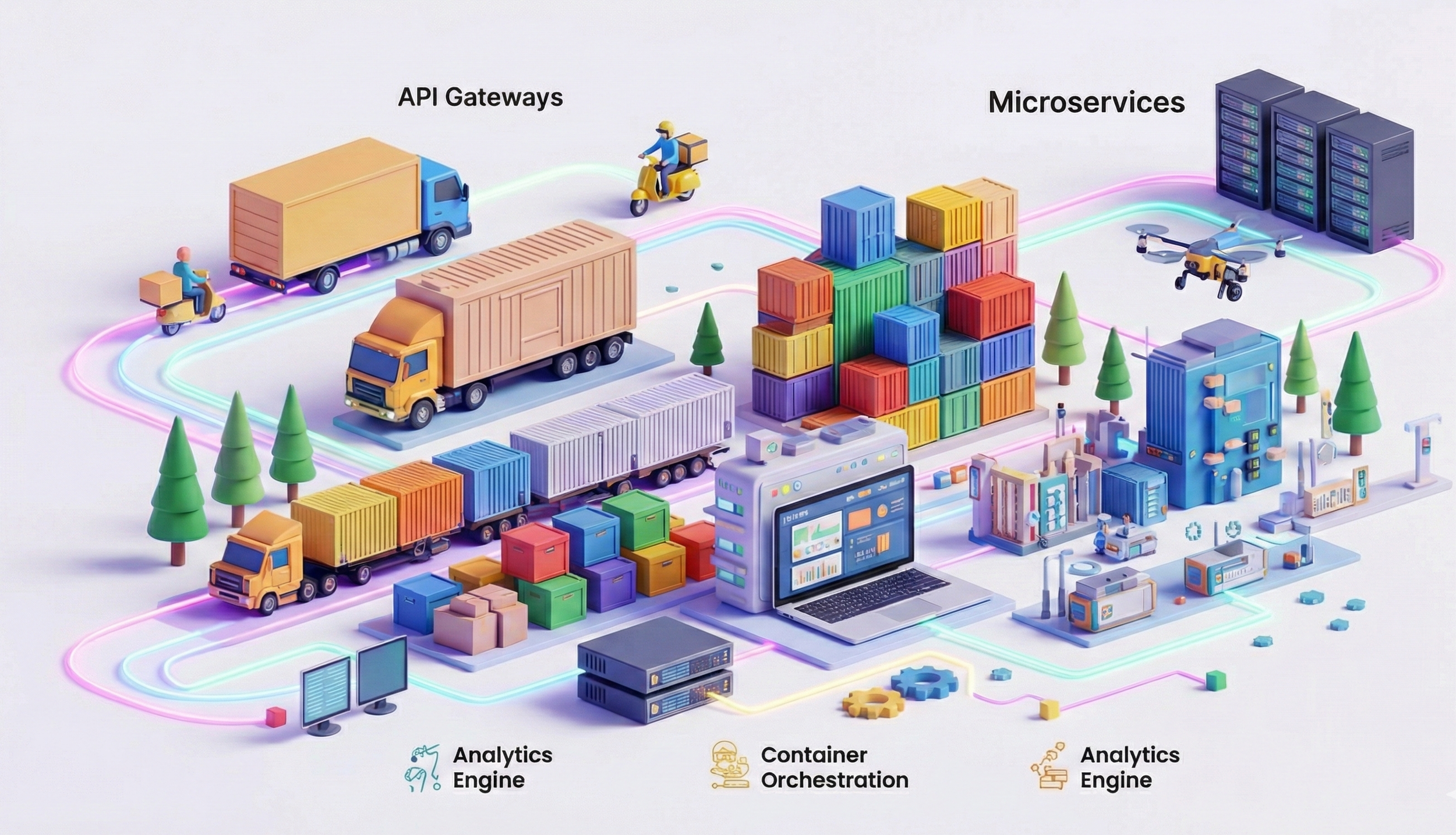
Technology LayerFunctionBusiness ImpactAPI GatewaysManage service-to-service communicationEnable ecosystem partnershipsMicroservices ArchitectureBreak applications into independent componentsAccelerate feature deploymentContainer OrchestrationAutomate scaling and resource managementReduce infrastructure costsAnalytics EnginesProcess delivery metrics in real-timeInform strategic decisions
This architecture isn't just for tech companies. Organizations in financial services, healthcare, retail, and government are all adopting these patterns to modernize how they serve customers and stakeholders.
The Strategic Value of Digital Delivery Transformation
Leaders often underestimate the strategic implications of how delivery services operate. The difference between a well-designed delivery system and a fragmented one shows up in revenue, customer retention, and organizational agility. When delivery services function as integrated systems rather than disconnected tools, organizations gain several competitive advantages.
Speed becomes a strategic weapon. Companies that reduce their cycle time from idea to customer feedback can iterate faster than competitors. This velocity compounds over time, creating knowledge advantages that are difficult to replicate. The Delivery-as-a-Service market has grown precisely because organizations recognize that delivery speed directly correlates with market share.
Risk profiles change fundamentally. Traditional big-bang releases carry massive risk because they concentrate uncertainty into single moments. Digital delivery services enable incremental deployment, testing assumptions with real customers before full rollout. This approach transforms risk management from a gate-keeping function to a continuous optimization process.
Resource allocation becomes dynamic. Instead of committing resources months in advance based on static plans, modern delivery systems allow organizations to redirect capacity based on real-time demand signals. This flexibility is especially valuable in volatile markets where customer preferences shift rapidly.
Breaking Down Organizational Silos
One of the most powerful but least discussed benefits of digital delivery services is their impact on organizational structure. When delivery systems require cross-functional collaboration by design, they force conversations that break down traditional departmental boundaries.
Consider a typical product launch in a traditional organization:
Strategy team develops concept
Design team creates specifications
Engineering builds the product
Operations prepares for deployment
Marketing plans the launch
Sales trains on new offering
Each handoff creates delay and information loss. Digital delivery services collapse these stages into continuous workflows where teams collaborate simultaneously. Agile and digital transformation methodologies support this shift by establishing shared rituals and transparent communication channels.
Organizations implementing these changes report 30-50% reductions in time-to-market and significant improvements in employee satisfaction. The elimination of waiting between stages reduces frustration and creates space for creative problem-solving.
Overcoming Implementation Challenges
Despite clear benefits, many organizations struggle to implement effective digital delivery services. The challenges extend beyond technology to encompass culture, skills, and governance. Understanding these barriers helps leaders develop more realistic transformation roadmaps.
Common Barriers and Solutions
Research on digital marketing and delivery in developing markets identifies several persistent challenges that apply across geographies and industries:

Legacy system integration – Existing infrastructure wasn't designed for continuous delivery
Skill gaps – Teams lack experience with modern tools and practices
Governance friction – Traditional approval processes conflict with rapid iteration
Cultural resistance – Established workflows create organizational inertia
ChallengeTraditional ResponseModern ApproachLegacy SystemsRip and replaceAPI abstraction layersSkill GapsExternal hiringEmbedded capability buildingGovernance FrictionException processesAutomated compliance checkingCultural ResistanceChange management programsPilot teams demonstrating value
The most successful transformations address these challenges systematically rather than treating them as isolated problems. Building high-impact transformation teams that can navigate both technical and cultural dimensions becomes essential.
The Role of Leadership in Delivery Transformation
Executive sponsorship matters enormously in digital delivery transformations, but not in the ways leaders typically assume. Rather than focusing solely on budget approvals and milestone tracking, effective sponsors create conditions where teams can experiment safely and learn quickly.
This involves:
Redefining success metrics. Traditional measures like on-time, on-budget completion don't capture the value of learning or the option value of flexibility. Leaders need to balance delivery velocity with outcome quality and team health.
Protecting experimental capacity. Organizations tend to allocate 100% of capacity to committed work, leaving no space for exploration. Reserving 10-20% of capacity for experiments enables innovation without disrupting core operations.
Modeling transparent communication. When leaders openly discuss failures and adjustments, they signal that adaptation is expected rather than punished. This psychological safety is foundational for high-performing delivery teams.
Leading transformation effectively requires understanding that digital delivery isn't a project with a defined endpoint-it's an ongoing capability that needs continuous investment and attention.
Technology Trends Shaping Delivery Services
The digital delivery landscape continues evolving rapidly as new technologies mature and integrate into mainstream practice. Organizations planning their 2026 strategies need to understand which trends represent genuine opportunities versus hype cycles.
Artificial Intelligence in Delivery Optimization
AI has moved from experimental to essential in digital delivery services. The technology now powers multiple aspects of delivery systems, from predictive resource allocation to automated quality assurance. AI transformation strategies help organizations identify where machine learning creates the most value.
Practical AI applications in delivery include:
Demand forecasting that adjusts capacity before bottlenecks form
Anomaly detection that identifies issues before they impact customers
Intelligent routing that optimizes delivery paths based on real-time conditions
Automated testing that validates changes against expected behaviors
Personalization engines that customize experiences for individual users
The digital logistics market has seen significant growth driven by these AI capabilities, particularly in sectors where timing and precision directly affect business outcomes.
However, AI implementation requires careful attention to workflow integration. Organizations that simply bolt AI onto existing processes often see disappointing results. The technology works best when delivery workflows are redesigned to leverage machine intelligence while maintaining human judgment where it adds unique value.
Automation and the Middle Layer
One of the most impactful trends in digital delivery services is the automation of repetitive coordination tasks. These "middle layer" activities-status updates, handoff notifications, progress tracking-consume significant time but add little strategic value. Automating the middle frees teams to focus on complex problem-solving and customer interaction.
Modern delivery platforms now include:
Automated deployment orchestration
Self-service provisioning for development environments
Intelligent notification systems that reduce alert fatigue
Workflow automation that triggers actions based on defined conditions
These capabilities don't eliminate human involvement-they elevate it. Instead of manually coordinating handoffs, team members focus on exception handling and strategic decisions that require nuanced judgment.
Sustainability and Ethical Considerations
As digital delivery services scale globally, trends shaping the future of delivery increasingly include sustainability and ethical operation. Organizations face growing pressure from customers, regulators, and employees to operate responsibly.

This manifests in several ways:
Energy efficiency in data centers and networks reduces environmental impact while lowering operational costs. Organizations are optimizing delivery architectures to minimize unnecessary computation and data transfer.
Transparent data practices build trust with customers who are increasingly aware of how their information is used. Privacy-preserving delivery methods enable personalization without excessive data collection.
Inclusive design ensures digital services remain accessible regardless of user capabilities or connectivity constraints. This expands market reach while fulfilling ethical obligations.
Organizations that integrate these considerations into delivery design from the outset avoid costly retrofits and reputational risks later.
Building Capability for Continuous Delivery
Technology alone doesn't create effective digital delivery services. Organizations need people with the right skills, operating in environments that support rapid learning and adaptation. Building this capability requires intentional investment in team development and organizational design.
Essential Skills and Roles
Modern delivery teams blend technical expertise with business acumen and customer empathy. The most effective teams include:
Product managers who translate business strategy into delivery priorities
Platform engineers who build and maintain delivery infrastructure
Site reliability engineers who ensure system stability and performance
User experience designers who optimize customer interactions
Data analysts who extract insights from delivery metrics
Beyond individual skills, teams need collective capabilities like collaborative problem-solving, effective conflict resolution, and shared learning practices. Creating teams successfully requires attention to both individual competencies and team dynamics.
Organizations increasingly recognize the value of embedded consultants who combine deep expertise with the ability to transfer knowledge. Rather than maintaining permanent staff for every specialty, they engage experts who solve immediate problems while building internal capability.
Training Approaches That Actually Work
Traditional training programs often fail to create lasting capability change because they separate learning from application. Participants attend workshops, gain theoretical knowledge, but struggle to apply concepts when they return to daily work pressures.
Effective capability building for digital delivery services uses different approaches:
Embedded coaching where experts work alongside teams on real challenges
Deliberate practice with immediate feedback on concrete tasks
Community learning where teams share experiences and solutions
Progressive exposure that builds complexity gradually as competence grows
This experiential approach accelerates skill development while producing tangible business results. Teams solve actual problems while learning new methods, creating both immediate value and lasting capability.
Measuring Digital Delivery Success
Organizations need clear metrics to evaluate whether their digital delivery services are performing effectively. However, traditional metrics often measure the wrong things, creating perverse incentives that undermine strategic goals.
Beyond Velocity: Meaningful Metrics
Many organizations track delivery velocity-how much work teams complete in a given period. While speed matters, focusing exclusively on throughput can encourage cutting corners or inflating estimates. More sophisticated measurement approaches balance multiple dimensions:
Metric CategoryExample MeasuresWhat It RevealsFlow EfficiencyCycle time, lead timeHow smoothly work moves through the systemQualityDefect rates, customer-reported issuesWhether speed comes at quality's expenseReliabilityUptime, mean time to recoverySystem stability and resilienceOutcomesCustomer satisfaction, business KPIsWhether delivery creates intended value
The best measurement frameworks connect delivery metrics to business outcomes. Growth analytics help organizations understand which delivery improvements actually drive revenue, retention, or other strategic goals.
Learning from Delivery Data
Digital delivery services generate massive amounts of data about how work flows through organizations. This data represents an underutilized strategic asset for most companies. Analyzing delivery patterns reveals bottlenecks, dependencies, and opportunities for improvement that aren't visible through anecdotal observation.
Advanced organizations use delivery data to:
Predict delivery timelines more accurately by analyzing historical patterns
Identify systemic issues that affect multiple teams or products
Optimize resource allocation based on actual capacity and demand
Validate transformation investments by measuring before and after states
This evidence-based approach to improvement builds confidence in transformation decisions and helps prioritize the highest-impact changes.
Industry-Specific Considerations
While digital delivery principles apply broadly, different sectors face unique challenges that require tailored approaches. Understanding these nuances helps organizations implement delivery services that align with their specific regulatory, operational, and competitive contexts.
Financial Services and Compliance
Banks, insurers, and investment firms operate under strict regulatory oversight that affects how they implement digital delivery services. The tension between compliance requirements and delivery speed creates unique design challenges.
Successful financial services digital transformation balances regulatory compliance with operational efficiency through:
Automated compliance checking embedded directly in delivery pipelines
Audit trails that document every change and decision
Graduated deployment that limits risk exposure during rollouts
Regulatory sandbox environments for testing innovations safely
These organizations can't sacrifice compliance for speed, but they can eliminate unnecessary manual processes that slow delivery without adding regulatory value.
On-Demand Services and Customer Expectations
Companies operating in on-demand markets face different pressures. The on-demand food delivery industry, for example, deals with real-time logistics challenges where minutes matter. Digital delivery services in these contexts must optimize for:
Sub-second response times for customer requests
Dynamic routing that adapts to changing conditions
Predictive positioning that anticipates demand patterns
Exception handling that recovers gracefully from disruptions
The delivery infrastructure itself becomes the product in these businesses. Investments in delivery capabilities directly affect competitive positioning and customer satisfaction.
Public Sector and Accessibility
Government organizations implementing digital delivery services must balance efficiency with universal access. Not all citizens have high-speed internet or digital literacy, yet all deserve quality service. This creates design constraints that commercial organizations may not face.
Effective public sector delivery includes:
Multi-channel approaches that offer digital and traditional options
Progressive enhancement that works on basic devices and connections
Clear communication accessible to people with varying literacy levels
Privacy protection that exceeds minimum legal requirements
These considerations don't prevent innovation-they redirect it toward inclusive solutions that serve entire populations rather than just digitally savvy segments.
The Human Element in Digital Delivery
Despite the emphasis on technology and automation, successful digital delivery services ultimately depend on people. The organizations that excel at delivery create environments where human creativity, judgment, and empathy complement technological capabilities rather than competing with them.
Maintaining Team Health During Transformation
Delivery transformations create pressure on teams as they learn new tools, adopt unfamiliar practices, and navigate organizational uncertainty. Without careful attention to team health, transformation initiatives can burn out the very people needed to sustain them.
Warning signs of unsustainable delivery practices include:
Chronic overtime becoming normalized rather than exceptional
Declining code quality as teams rush to meet arbitrary deadlines
Increased turnover among experienced team members
Reduced innovation as all capacity goes to committed work
Leaders can protect team health by setting realistic expectations, celebrating learning alongside delivery, and modeling sustainable work practices. Transformation engineering approaches emphasize building systems that support long-term team effectiveness rather than short-term output maximization.
Customer-Centricity in Delivery Design
The ultimate purpose of digital delivery services is creating value for customers. Yet many organizations optimize their delivery systems for internal convenience rather than customer outcomes. This inside-out thinking leads to solutions that work well technically but fail to address actual customer needs.
Product and service design that prioritizes customer experience starts by understanding customer jobs-to-be-done rather than feature lists. Delivery systems then optimize for the metrics that matter to customers-problem resolution time, interaction quality, outcome achievement-rather than just internal efficiency.
This customer focus influences delivery architecture, team composition, and success metrics. Organizations structured around customer journeys rather than internal functions deliver more coherent experiences because their delivery services align with how customers actually interact with the business.
Digital delivery services represent far more than operational improvements-they're strategic capabilities that determine how effectively organizations turn strategy into outcomes. The organizations thriving in 2026 have moved beyond treating delivery as a technical problem to be solved and instead view it as a continuous practice that requires investment, attention, and evolution. Success requires balancing technological capability with human judgment, speed with sustainability, and innovation with reliability. If your organization is ready to transform how it delivers value to customers and stakeholders, Lithe can help you design and implement delivery systems that actually work-combining strategic vision with hands-on execution to achieve measurable results.
