
The landscape of modern business continues to shift as organizations discover the power of combining structured engineering principles with intelligent automation capabilities. Engineering and automation together represent more than technological advancement; they embody a fundamental reimagining of how work gets done, how teams collaborate, and how value flows from strategy to customer outcomes. Companies that master this combination don't just move faster-they build systems that adapt, learn, and improve continuously while maintaining the rigor and reliability that engineering disciplines demand.
The Strategic Foundation of Engineering and Automation
Engineering disciplines have always emphasized precision, repeatability, and systematic problem-solving. When these principles merge with automation technologies, organizations gain the ability to scale expertise and embed knowledge directly into their operational systems. This isn't about replacing human judgment with machines; it's about creating environments where engineering rigor amplifies automation capabilities and vice versa.
Why Traditional Approaches Fall Short
Many organizations approach engineering and automation as separate initiatives. The engineering team focuses on architecture, design, and technical standards while a different group pursues automation opportunities. This separation creates gaps:
Disconnected optimization that improves individual processes without system-wide thinking
Technical debt accumulation when automation lacks proper engineering foundations
Missed opportunities for compound improvements across domains
Resistance from teams who see automation as threat rather than capability enhancement
Organizations that succeed treat engineering and automation as complementary disciplines requiring unified strategy and execution.
Building Blocks for Integrated Success
A successful engineering and automation strategy rests on several foundational elements. First, clear architectural principles ensure that automated systems integrate seamlessly with existing infrastructure while remaining flexible enough to evolve. Second, data quality and accessibility become paramount-automation can only be as good as the information it processes. Third, cross-functional collaboration breaks down silos between engineers, operations teams, and business stakeholders.
The International Society of Automation provides frameworks and standards that help organizations navigate these complexities, offering guidance on everything from control systems to safety protocols.

Practical Applications Across Business Functions
Engineering and automation transform multiple aspects of organizational operations. The key lies in identifying where systematic thinking and automated execution create the greatest leverage.
Workflow Redesign and Process Engineering
Before automating any process, organizations must engineer it properly. This means mapping current states, identifying bottlenecks, and redesigning workflows for both human and machine efficiency. Many failed automation projects stem from automating broken processes-essentially making bad workflows fail faster.
Process engineering starts with understanding value streams. What activities directly contribute to customer outcomes? Which steps introduce waste or delay? Where do handoffs create friction? Once these questions are answered, automation can be applied strategically to eliminate repetitive tasks, reduce error rates, and accelerate throughput.
Modern approaches to transformation engineering emphasize this systematic redesign as a prerequisite to automation investment.
Process Engineering PhaseAutomation OpportunityExpected ImpactValue stream mappingIdentify automation candidates15-25% efficiency gainBottleneck analysisPrioritize high-impact areas30-40% cycle time reductionWorkflow redesignRemove unnecessary steps20-35% cost reductionIntegration planningConnect systems end-to-end40-50% error reduction
Decision Support and Knowledge Systems
Engineering and automation converge powerfully in decision-making contexts. Organizations accumulate enormous expertise in their people, but that knowledge often remains trapped in individual minds or scattered documents. Engineering this knowledge into automated decision support systems democratizes expertise and ensures consistent application of best practices.
Research in machine learning frameworks for automation engineering demonstrates how predictive models can assist engineers in making better decisions about code structure, hardware selection, and system design. These tools don't replace engineering judgment; they augment it by processing variables and patterns beyond human capacity.
Consider product development teams that must balance customer requirements, technical constraints, resource availability, and strategic priorities. Automated scoring systems can process these multidimensional inputs, flag potential conflicts, and suggest optimal paths forward-all while engineers retain final decision authority.
Infrastructure and Platform Engineering
The rise of platform thinking has transformed how organizations approach engineering and automation infrastructure. Rather than building point solutions for individual needs, leading companies create platforms that make both engineering work and automation deployment faster, safer, and more consistent.
Platform engineering involves creating reusable components, standardized interfaces, and self-service capabilities. When done well, it allows teams across the organization to leverage automation without deep technical expertise. The platform handles complexity-security, scalability, monitoring, compliance-while users focus on business logic and outcomes.
Publications like Control Engineering and Automation World regularly feature case studies showing how organizations build these platforms across manufacturing, logistics, and service industries.
The Human Dimensions of Engineering and Automation
Despite technological sophistication, engineering and automation initiatives succeed or fail based on human factors. Culture, capability, and change management determine whether systems deliver intended value.
Capability Development and Skill Evolution
As automation handles routine tasks, engineering roles evolve toward higher-level problem-solving, system design, and continuous improvement. This shift requires intentional capability building. Organizations must help engineers transition from execution-focused work to orchestration and optimization.
Effective training programs combine technical skills with business context. Engineers need to understand not just how automation works but why certain processes matter, how different business units interact, and what outcomes drive value. This broader perspective enables better system design and more impactful automation choices.
Building high-impact transformation teams requires deliberate investment in both technical and adaptive capabilities, ensuring teams can navigate the complexity engineering and automation introduce.
Designing for Human-Machine Collaboration
The best engineering and automation solutions enhance human capabilities rather than attempting to eliminate people entirely. This requires thoughtful interface design, clear escalation paths, and feedback mechanisms that allow continuous learning.
Consider customer service automation. Rather than replacing agents with chatbots, sophisticated systems handle routine inquiries while surfacing complex cases to humans with full context and suggested solutions. The automation does what machines do well (rapid information retrieval, pattern matching, consistent application of rules) while preserving what humans do best (empathy, nuanced judgment, creative problem-solving).
Research on assistance systems for low-code platforms shows how domain experts can be supported rather than replaced, reducing complexity while maintaining human oversight and control.
Managing Change and Building Trust
Introducing engineering and automation changes how people work, sometimes dramatically. Without proper change management, even technically excellent solutions face resistance and underutilization. Trust building requires transparency about automation's purpose, clear communication about impact on roles, and early involvement of affected teams in design decisions.
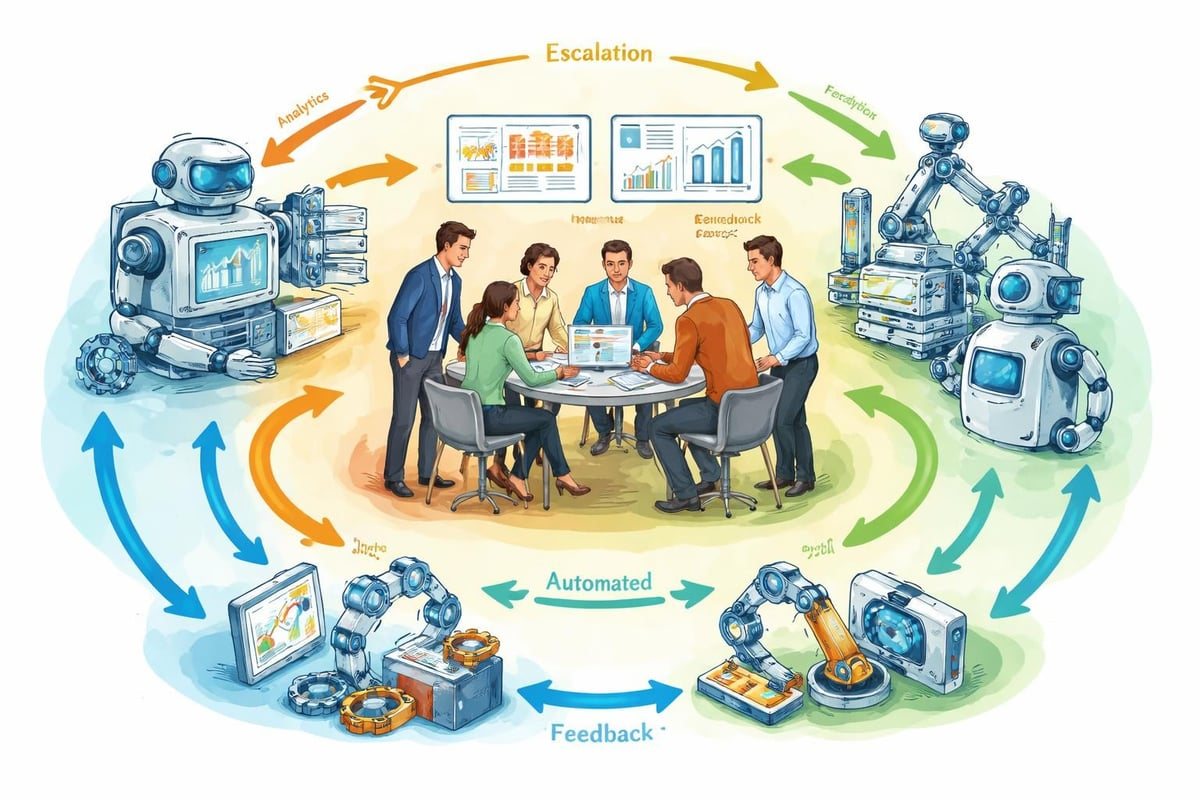
Organizations that excel at automating operational workflows emphasize the "why" as much as the "how," helping teams understand how automation creates capacity for more meaningful work rather than threatening job security.
Architectural Patterns and Technical Approaches
Successful engineering and automation requires sound technical architecture. Several patterns have emerged as particularly effective for organizations pursuing integrated approaches.
Modular Design and Composability
Breaking complex systems into smaller, reusable components makes both engineering and automation more manageable. Each module handles a specific function with well-defined inputs and outputs. This modularity enables parallel development, easier testing, and incremental deployment.
The AutomationML standard exemplifies this approach, providing neutral data formats that allow different engineering tools to exchange information seamlessly. Organizations adopting similar principles can mix and match components, replace underperforming elements, and adapt systems as needs evolve without complete rebuilds.
Event-Driven Architecture
Many engineering and automation scenarios benefit from event-driven designs where systems respond to triggers rather than running on fixed schedules. When an order is placed, inventory updated, or threshold exceeded, relevant automation workflows activate automatically.
Event-driven approaches reduce latency, improve resource efficiency, and create more resilient systems. They also align well with modern cloud architectures and microservices patterns increasingly common in enterprise environments.
Integration and Interoperability
Engineering and automation systems rarely operate in isolation. They must connect with existing enterprise applications, data sources, and operational systems. Robust integration strategies emphasize:
API-first design that makes systems naturally connectable
Standard protocols that reduce custom integration work
Data transformation layers that handle format and schema differences
Error handling and retry logic that maintain reliability
Monitoring and observability that provide visibility across integrated systems
Research on semantic integration in digital engineering explores how ontologies and shared models can improve interoperability across engineering domains, reducing friction in automated workflows.
Measuring Impact and Continuous Improvement
Engineering and automation investments require clear metrics and ongoing optimization. Organizations that treat deployment as the finish line miss opportunities for compound returns through systematic refinement.
Establishing Baseline Metrics
Before implementing engineering and automation changes, establish clear baselines across relevant dimensions:
Process efficiency (cycle time, throughput, resource utilization)
Quality metrics (error rates, rework frequency, customer satisfaction)
Cost structure (labor costs, infrastructure expenses, operational overhead)
Capability metrics (time to market, innovation rate, scalability limits)
These baselines enable objective assessment of automation impact and inform prioritization of future improvements.
Continuous Monitoring and Optimization
Engineering and automation systems generate rich data about their own performance. Organizations should instrument systems to capture not just outcomes but operational characteristics: which automations run most frequently, where failures occur, which decision paths get taken, and how different scenarios affect performance.
This telemetry feeds continuous improvement cycles. Engineers analyze patterns, identify optimization opportunities, and iterate on system design. Over time, this compounding improvement delivers returns far exceeding initial deployment benefits.
The AI and automation landscape continues evolving, with machine learning increasingly embedded in monitoring and optimization workflows themselves, creating self-improving systems.
Scaling Engineering and Automation Across Organizations
Point solutions deliver value, but enterprise-wide scaling of engineering and automation creates transformational impact. Scaling requires governance, standardization, and organizational alignment.
Governance Models That Enable Innovation
Effective governance balances control with autonomy. Too much centralization stifles innovation and slows deployment; too little creates chaos, security risks, and technical debt. Leading organizations adopt federated models where central teams establish standards, provide platforms, and ensure compliance while business units retain autonomy in applying engineering and automation to their specific needs.
Governance frameworks should address:
Security and compliance requirements that all automation must meet
Data handling standards ensuring privacy and regulatory adherence
Integration protocols that maintain system interoperability
Change management processes balancing speed with stability
Cost allocation models that fund both central capabilities and business unit initiatives
Center of Excellence Approaches
Many organizations establish centers of excellence (CoEs) to drive engineering and automation maturity. These teams combine deep technical expertise with business acumen, helping prioritize opportunities, share best practices, and build organizational capability.
Effective CoEs don't become bottlenecks. They enable others through training, tooling, and support rather than controlling all automation work. This distributed model scales much faster while maintaining quality through shared standards and reusable components.
Organizations building AI centers of excellence demonstrate how specialized teams can accelerate adoption while ensuring responsible, effective implementation.
Knowledge Sharing and Community Building
Engineering and automation knowledge spreads through communities of practice, not just training programs. Creating forums where practitioners share challenges, solutions, and innovations accelerates learning and reduces duplicated effort.
Internal developer conferences, regular showcases, and collaborative platforms help surface successful patterns and cautionary tales. This social learning complements formal training and documentation, building collective intelligence that elevates organizational capability.
Future Directions in Engineering and Automation
The field continues evolving rapidly. Several trends will shape how organizations approach engineering and automation over coming years.
AI-Augmented Engineering
Artificial intelligence is moving beyond automation of routine tasks into augmenting engineering work itself. Large language models supporting software architecture design demonstrate how AI can simulate different stakeholder perspectives, identify design trade-offs, and suggest architectural patterns based on requirements.
These capabilities don't replace engineers but give them superpowers-analyzing more alternatives faster, identifying issues earlier, and freeing time for creative problem-solving. Organizations that integrate AI into engineering workflows gain significant productivity and quality advantages.
Low-Code and No-Code Evolution
Platforms that reduce engineering complexity through visual interfaces and pre-built components continue maturing. These tools democratize automation, enabling business users to build solutions without deep technical expertise.
However, engineering rigor remains essential. Agile AI workflows emphasize the need for proper testing, governance, and lifecycle management even when initial development appears simple. The goal isn't eliminating engineering but making it more accessible and efficient.
Sustainability and Resource Optimization
Engineering and automation increasingly focus on environmental impact and resource efficiency. Automated systems that optimize energy consumption, reduce waste, and minimize carbon footprint align business performance with sustainability goals.
Research published in Automation in Construction explores how advanced automation methods can improve efficiency in the built environment, reducing both costs and environmental impact simultaneously.
Adaptive and Self-Optimizing Systems
Future engineering and automation systems will adjust themselves based on changing conditions. Machine learning enables systems that detect performance degradation, identify root causes, and implement optimizations autonomously-within boundaries engineers define.
This shift from static automation to adaptive systems represents the next frontier, where engineering work focuses increasingly on setting objectives, defining constraints, and monitoring outcomes while systems handle tactical optimization.
Practical Steps for Organizations Starting Today
Organizations at any maturity level can begin strengthening their engineering and automation capabilities. Success requires starting with clear intent and building momentum through early wins.
Assessment and Opportunity Mapping
Begin by understanding current state across three dimensions:
Technical maturity - What engineering practices and automation capabilities exist today?
Process readiness - Which workflows are well-documented, stable, and suitable for automation?
Organizational capacity - Do teams have necessary skills, time, and support to execute?
This assessment reveals where to focus initial efforts for maximum impact with manageable risk.
Pilot Programs and Learning Cycles
Rather than attempting enterprise-wide transformation immediately, launch focused pilots that demonstrate value and build capability. Choose opportunities with:
Clear business value that justifies investment and maintains stakeholder support
Manageable scope allowing completion within 8-12 weeks
Learning potential exposing teams to new approaches and building confidence
Scalability serving as templates for broader rollout
Document lessons from each pilot, sharing both successes and challenges to accelerate organizational learning.
Building the Operating Model
As engineering and automation scale beyond pilots, establish the operating model that will sustain and accelerate progress:
Funding mechanisms that balance central investment with business unit contributions
Talent strategies combining hiring, training, and partnering to access needed skills
Technology roadmaps guiding platform evolution and tool selection
Measurement frameworks tracking both tactical metrics and strategic outcomes
Communication cadences keeping stakeholders informed and engaged
Organizations often benefit from external transformation partners who bring experience, accelerate capability building, and help navigate common pitfalls.
Engineering and automation together create powerful leverage for organizations willing to invest in both technical capabilities and organizational change. The systematic thinking engineering provides ensures automation delivers sustainable value rather than creating new problems. When you're ready to strengthen how your organization approaches these opportunities, Lithe combines transformation strategy with hands-on delivery to help you redesign workflows, embed automation thoughtfully, and build capabilities that compound over time. We blend engineering rigor with agile execution to turn your vision into measurable outcomes.
