
Guide to Accelerate Innovation: Strategies for 2026
Only 21% of organizations meet their innovation goals, while slow go-to-market timelines continue to threaten competitiveness. As 2026 approaches, the pressure to accelerate innovation has never been greater.
This guide delivers practical, research-backed strategies to help you break through common barriers and accelerate innovation within your organization. Discover proven frameworks, learn how to overcome cultural and structural obstacles, and master step-by-step innovation sprint methods.
Explore techniques for measuring and scaling success so your team can adapt quickly and outperform the competition. Ready to transform your innovation approach? Start your journey with this actionable roadmap.
Understanding the Innovation Challenge in 2026
The race to accelerate innovation is fiercer than ever as organizations confront rapid technological change and shifting market dynamics. With only 21% of companies achieving their innovation goals, according to Informa (2024), the pressure to innovate quickly and effectively is mounting. Organizations that fail to keep pace risk falling behind, losing billions to failed initiatives and sluggish go-to-market timelines.
The Evolving Innovation Landscape
Digital transformation and generative AI are fundamentally reshaping how organizations operate and compete. Companies must now accelerate innovation to keep up with shorter product cycles and rapidly evolving customer expectations. The pace of change is relentless: the average concept-to-launch process still takes 22 months, yet competitors are compressing these timelines with agile methods and AI-driven insights.
The stakes are high. Globally, $2.3 trillion is wasted annually on failed digital transformations, highlighting the cost of slow or ineffective innovation. As digital natives and disruptors enter every sector, traditional organizations face mounting pressure to deliver value faster. Accelerating innovation is no longer optional; it is essential for survival in 2026.
Barriers to Accelerated Innovation
Despite the urgency, many organizations struggle to accelerate innovation due to deeply rooted cultural and structural obstacles. Fear-based decision-making, misaligned incentives, and perfectionist mindsets often stifle experimentation and risk-taking. Outdated processes can turn teams cautious, while resource borrowing and departmental resistance derail momentum.
BarrierImpactRisk aversionLimits experimentationResource borrowingDisrupts sprint focusLack of executive buy-inStalls decision-making
Traditional enterprises often lag behind agile startups, whose flatter structures and adaptive cultures empower teams to move quickly. Overcoming these barriers requires a deliberate shift. For actionable strategies on building a culture that supports and sustains innovation, see Real Business Agility and Culture.
The Strategic Imperative for 2026
In 2026, to accelerate innovation is to future-proof your organization. Maintaining the status quo while competitors outpace you can mean losing market share and relevance. Speed and adaptability are not just advantages—they are necessities.
Leadership plays a pivotal role in this transformation. Executives must champion innovation, provide clear priorities, and remove obstacles that slow teams down. Organizations that invest in the right culture, structures, and leadership attention will be best positioned to accelerate innovation and thrive in an increasingly competitive landscape.
Step 1: Building Priority-Protected, Cross-Functional Teams
To accelerate innovation in 2026, organizations must rethink how teams are formed and protected. Traditional project teams often struggle with distractions, misaligned priorities, and operational demands. Creating a dedicated, cross-functional team structure is essential for rapid progress and breakthrough results.

Assembling the Right Team for Innovation Sprints
The foundation to accelerate innovation starts with assembling a “priority-protected pod.” This team is shielded from day-to-day operational noise so they can focus fully on their innovation sprint. What does this look like in practice?
First, the team is led by a single-threaded leader (STL), someone dedicated to the sprint’s objectives without competing responsibilities. The core group includes members from business, technical, and design backgrounds. Each member brings unique expertise, which helps tackle challenges from every angle.
To truly accelerate innovation, these pods must devote more than 50% of their working hours to the sprint. Anything less, and progress stalls. Leadership must provide “executive air cover” by removing distractions, approving quick decisions, and visibly supporting the team’s mission.
For example, a health app project might include a product manager (STL), a mobile developer, a UX designer, and a data analyst. At companies like AWS, similar pods work independently on new services, with leaders ensuring their focus is not diluted by unrelated tasks.
Want a deeper dive into structuring these high-performing teams? The guide on Building High-Impact Transformation Teams explores proven practices that help organizations accelerate innovation with priority-protected teams and clear roles.
Overcoming Resource and Alignment Challenges
Even with the right team, accelerating innovation can be derailed by resource borrowing and misalignment. Departments may try to “borrow back” team members for old priorities, or resist new sprint goals. How can organizations prevent this?
Start by creating a pact: sprint goals are nonnegotiable, and team members remain fully dedicated. Next, implement “Do Not Disturb” protocols, such as blocking sprint time on calendars and minimizing meeting interruptions.
Daily alignment check-ins help teams course-correct quickly. These brief meetings ensure everyone is focused, obstacles are flagged, and priorities are clear. If misalignment arises, leaders need to step in immediately to restore focus.
Tracking alignment is also vital. Use simple dashboards to monitor time allocation and sprint progress. If a team member’s attention drifts, address it right away. According to McKinsey, 82% of engineers are constantly seeking ways to accelerate innovation, but lack of clarity and shifting priorities hold them back.
By formalizing these practices, organizations create an environment where teams can accelerate innovation without competing demands. This step is the bedrock for all subsequent innovation success.
Step 2: Customer Discovery Through Ethnographic Research
Understanding your customers is the cornerstone of efforts to accelerate innovation. Many organizations fall into the trap of relying on assumptions or surface-level data, missing the deeper insights that drive breakthrough solutions. In this step, we explore why traditional research methods often fall short and how ethnographic research fuels rapid, customer-centric innovation.

Moving Beyond Traditional Research Methods
Traditional research tools like focus groups and surveys are common, but they rarely provide the depth needed to accelerate innovation. These methods often yield superficial feedback, as participants may say what they think researchers want to hear. Relying on past experiences or assumptions can lead teams down the wrong path, resulting in wasted time and missed opportunities.
The danger lies in treating customer needs as static or universal. In reality, preferences shift rapidly, especially as digital transformation and generative AI reshape the market. To accelerate innovation, organizations must dig deeper than what customers say in a controlled setting.
Here are common pitfalls with traditional methods:
Overemphasis on quantitative data without context
Failure to observe real-world behavior
Ignoring emotional drivers and pain points
Accelerate innovation by committing to richer, more nuanced discovery. Deep customer understanding isn’t just about asking questions, but about observing true behaviors and unmet needs. For organizations serious about change, this means challenging internal biases and replacing guesswork with genuine empathy.
Customer-centric discovery is a proven way to accelerate innovation. For more on how customer experience drives impactful change, see Innovation in Customer Experience.
Ethnographic Techniques for Real Insights
Ethnographic research goes beyond the surface, immersing teams in the daily lives of users. To accelerate innovation, consider these hands-on approaches:
Shadowing users: Observe customers as they interact with your product or service in their natural environment.
Journey mapping: Visualize every step of the user's experience, highlighting friction points and emotional highs or lows.
Open-ended interviews: Let users guide the conversation, revealing hidden frustrations and unexpected needs.
For example, a health app innovation team accelerated innovation by shadowing users through their daily routines. Instead of relying on survey responses, they noticed users struggled to interpret complex data. This insight led to a prototype focusing on simple, actionable health insights—something only immersive research could reveal.
Building customer-centric problem statements is essential to accelerate innovation. Clearly defining the core user pain point guides every sprint and keeps teams focused on delivering real value. Evidence-based discovery helps overcome organizational inertia, making it easier to align stakeholders and justify bold new directions.
To accelerate innovation, ethnographic research should be built into every innovation sprint, ensuring solutions are grounded in reality—not assumptions.
Step 3: Rapid Prototyping and Embracing Imperfection
Accelerating innovation in today’s environment means moving fast, learning quickly, and letting go of perfection. Rapid prototyping is the foundation for this approach. Instead of waiting for a flawless product, organizations create quick, low-fidelity versions that help teams test ideas, validate assumptions, and gather feedback.
This mindset is essential for teams looking to accelerate innovation and stay ahead of competitors. By embracing imperfection, organizations reduce waste, shorten feedback loops, and make better decisions early in the development process.
The Power of Low-Fidelity MVPs
Rapid prototyping relies on building just enough to learn, not to impress. Teams that accelerate innovation avoid the trap of perfectionism by focusing on the minimum viable product (MVP). An MVP is a simplified version of a solution that delivers core value and allows for immediate learning.
For example, a health app team might develop a prototype that offers just one actionable insight to users. This bare-bones version reveals whether users engage with the feature or ignore it. Such early feedback is priceless when organizations aim to accelerate innovation and stay responsive to customer needs.
Key principles for effective rapid prototyping include:
Start with simple sketches or clickable wireframes.
Gather real user feedback within days, not weeks.
Use prototypes to test assumptions, not to showcase design skills.
By keeping prototypes rough and ready, teams lower the stakes, encourage honest feedback, and foster a sense of momentum. This approach is a proven way to accelerate innovation and avoid costly delays.
Creating a Culture of Experimentation and Learning
A culture of experimentation is the backbone of any effort to accelerate innovation. Teams need psychological safety, where taking risks and learning from failure is not just accepted but expected. When risk-averse cultures dominate, fear of judgment can freeze progress and stall new ideas.
Organizations that accelerate innovation reward calculated risks and embrace early failures as stepping stones. Leaders play a critical role by modeling vulnerability, sharing their own mistakes, and normalizing learning from missteps.
Practical tools to build this culture include:
Time-boxed prototyping, such as 24-hour sprints for “ugly-first-draft” versions.
“Failure resumes,” where teams document lessons from failed experiments.
Scrap budgets that fund high-risk, high-learning prototypes.
Top-performing companies have shown that these practices are vital for ongoing success. In fact, innovation success rates in top companies often correlate with cultures that value experimentation and learning over perfection.
By fostering these behaviors, organizations accelerate innovation, adapt quickly, and turn insights into action faster than the competition.
Step 4: Measurement, Testing, and Actionable Metrics
Accelerate innovation by making measurement and testing central to your process. Without actionable metrics and rapid feedback, even the most promising ideas can stall or veer off track. This step is about building a culture of experimentation, using data to learn fast, and making decisions that keep teams moving forward.
Designing Effective Small-Scale Tests
Effective measurement starts with small, focused tests. To accelerate innovation, pilot your ideas with real users as early as possible. Instead of waiting for a perfect product, launch a minimal version and observe how people interact with it.
Start by identifying the riskiest assumptions. What must be true for your solution to succeed? Design tests that directly challenge these points. For example, a health app team might release a prototype that delivers one actionable health insight per day, then track if this leads to daily engagement or improved decision-making.
Key tips for designing tests that accelerate innovation:
Keep pilots small and time-boxed, such as one-week sprints.
Use real users, not just internal testers.
Gather both qualitative and quantitative feedback.
Focus on learning, not just proving success.
By tracking these metrics, organizations can accelerate innovation without getting lost in irrelevant data. Every test should end with clear, actionable insights.
Overcoming Bureaucracy and Vanity Metrics
Many organizations struggle to accelerate innovation because of slow approval processes and a focus on vanity metrics. Vanity metrics, such as total downloads or feature counts, may look impressive but rarely show if you are solving real problems.
To break free from these traps, streamline your testing approvals. Empower frontline teams to run experiments without waiting for executive committees. Fast decisions mean faster learning and quicker pivots.
Tracking "shadow metrics" can also reveal misalignment. For instance, if teams claim to prioritize user value but reward only speed, this gap becomes obvious in the data. Adjusting incentive systems to reward learning and impact, not just output, is crucial.
For deeper insight into measuring and proving agile transformation, explore Proving Agile Transformation Works, which details actionable measurement strategies that help accelerate innovation in any organization.
By focusing on outcome-based metrics and enabling teams to test quickly, companies can accelerate innovation, reduce wasted effort, and create products that truly matter.
Step 5: Analyzing Results, Learning, and Pivoting Fast
In the final phase to accelerate innovation, organizations must turn insights from testing into decisive action. Reviewing test results is not just about finding what works, but also identifying what does not. Teams should ask: Did the experiment validate our assumptions, or do we need to pivot? This step demands a culture ready to embrace learning, not just success.
Fear of failure is a major barrier when organizations aim to accelerate innovation. Many teams hesitate to admit when results fall short, fearing blame or lost credibility. However, embracing pivots as a sign of progress is essential. Learning from what did not work is just as valuable as scaling a win. In fact, product development failure statistics reveal that most new products miss the mark, making fast course correction a competitive advantage.
To track progress, use metrics like assumption kill rate—the percentage of tested ideas proven invalid—and pivot speed—how quickly teams respond to new information. These innovation metrics help quantify learning and reward bold, data-driven decisions.
Documenting and sharing lessons is vital to accelerate innovation. Use a Correction of Error (COE) process:
Capture what went wrong and why.
Identify root causes.
Share findings across teams.
Integrate lessons into future sprints.
Leaders play a crucial role in making pivots a normal part of the process. They must celebrate learning, encourage transparency, and model curiosity. When leadership openly discusses missteps and supports rapid change, it signals that continuous improvement is expected. This mindset shift is what truly enables organizations to accelerate innovation, adapt quickly, and stay ahead in 2026.
Breaking Through Barriers: Organizational and Leadership Strategies for Sustained Innovation
Organizations determined to accelerate innovation often face invisible walls. These barriers are not just about resources or technology. They are deeply rooted in structures, mindsets, and old habits that resist change.
Dismantling Structural and Psychological Barriers
To accelerate innovation, leaders must first recognize what holds teams back. Common culprits include perfectionism, misalignment between departments, and decision-making driven by fear. These issues slow response times and crush new ideas before they have a chance to grow.
Leadership plays a pivotal role in breaking these patterns. When leaders give sustained attention to innovation efforts and act as visible sponsors, teams feel empowered to take calculated risks. This sponsorship is more than words; it means providing resources, removing red tape, and celebrating learning, not just outcomes.
Building a culture that rewards experimentation is key to accelerate innovation. Organizations can start by piloting new methods in small teams. These pilots act as proof points, showing what is possible when barriers are removed. Once success is demonstrated, leaders can scale these practices across the organization.
Consider how European companies that rank high in the European Innovation Scoreboard 2024 often invest heavily in leadership training and cultural change. This investment pays off in faster product launches and higher adaptability.
Case studies reveal that when companies dismantle barriers and prioritize innovation, they not only keep pace with change but also leap ahead of competitors. Consistency from leadership and a willingness to rethink incentives are essential for lasting progress.
How Lithe Transformation Accelerates Innovation for Enterprises
Lithe Transformation offers a proven path for organizations ready to accelerate innovation at scale. Their approach embeds agile, digital, and AI-driven practices into the core of enterprise operations.
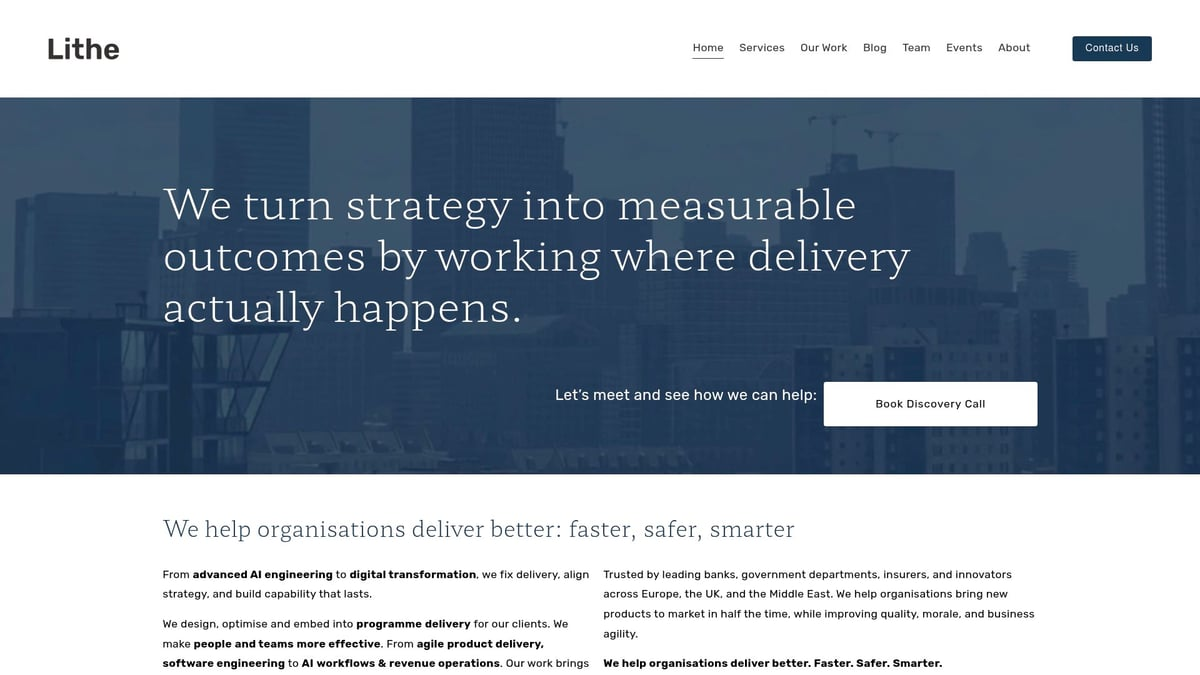
By focusing on transformation strategy, agile at scale, AI engineering, and capability building, Lithe helps organizations break down silos and foster a culture of innovation. Priority-protected teams receive the executive support they need to maintain focus and momentum.
Clients working with Lithe Transformation often see measurable improvements. Products reach the market faster, teams build lasting skills, and enterprises achieve meaningful, sustainable results. This approach helps organizations accelerate innovation in a way that sticks, rather than relying on one-off projects.
Lithe’s integrated method is especially valuable for large enterprises and government agencies. By aligning strategy with daily execution, they ensure that innovation is not just a buzzword but a repeatable process. For any organization seeking to accelerate innovation and stay ahead in 2026, these leadership and organizational strategies are essential.
You’ve seen how accelerating innovation isn’t just about speed—it’s about building the right teams, truly understanding your customers, and turning insights into action through rapid prototyping and smart measurement. If you’re ready to break through those old barriers and bring real, lasting change to your organization, you don’t have to go it alone. At Lithe Transformation, we help leaders like you redesign how work gets done, blending strategy with hands on delivery. Let’s make your innovation goals for 2026 a reality—Contact us now to get started.
